Financial Advisor Agent with MeTTa
Overview
This guide shows how to integrate SingularityNET's MeTTa (Meta Type Talk) knowledge graph with Fetch.ai's uAgents framework. The sample is a toy demo: it looks up illustrative risk → investment → return / allocation / goal facts in MeTTa, then uses ASI:One to classify intent and humanize the reply. It is not financial advice, not personalized recommendations, and is not a substitute for a licensed advisor.
Shared MeTTa + uAgent template: same layout and safety pattern as Medical Agent with MeTTa and Fetch.ai Knowledge Assistant with MeTTa (sibling review: issue #260).
Tested combo: Python 3.10–3.12, uagents>=0.25.5 (needs uagents-core 0.4.x), hyperon>=0.2.6. Chat Protocol samples need this runtime; Python 3.8 is not supported.
What is MeTTa?
MeTTa (Meta Type Talk) is SingularityNET's multi-paradigm language for declarative and functional computations over knowledge (meta)graphs. Official docs: MeTTa language and Hyperon. It provides:
- Structured Knowledge Representation: Organize information in logical, queryable formats
- Symbolic Reasoning: Perform complex logical operations and pattern matching
- Knowledge Graph Operations: Build, query, and manipulate knowledge graphs
- Space-based Architecture: Knowledge stored as atoms in logical spaces
Installation & Setup
Prerequisites
Before you begin, ensure you have:
- Python 3.10+ (3.10–3.12 recommended for
uagents0.25.x). On Windows usepy -3.10; on WSL/macOS/Linux usepython3. - pip package manager
- An ASI:One API key from the ASI:One API keys dashboard (not only the asi1.ai homepage)
Create a project folder and a virtual environment (do not install into system Python):
# macOS / Linux / WSL
python3 -m venv .venv
source .venv/bin/activate

# Windows PowerShell
py -3.10 -m venv .venv
.\.venv\Scripts\Activate.ps1
Create a .env file (never commit real secrets):
ASI_ONE_API_KEY=your_key_here
AGENT_SEED=change-me-to-a-unique-local-seed
# Optional: set LEARN=1 only if you want the demo to persist LLM guesses into the graph
# LEARN=1
Installation Options
Option 1: Install All Dependencies at Once (Recommended)
Create a requirements.txt file with one package per line:
openai>=1.0.0
hyperon>=0.2.6
uagents>=0.25.5
uagents-core>=0.4.9
python-dotenv>=1.0.0
uagents 0.25.x is tested with uagents-core 0.4.x (Chat Protocol). Keep uagents>=0.25.5 and uagents-core>=0.4.9 unless you intentionally upgrade the whole stack.
Install all dependencies with one command:
python3 -m pip install -r requirements.txt
On Windows: py -3.10 -m pip install -r requirements.txt.
Option 2: Verify Hyperon First
Use this only to confirm Hyperon/MeTTa installs on your machine. You still need Option 1 (requirements.txt) for uagents, openai, and python-dotenv.
python3 -m pip install hyperon
python3 -c "from hyperon import MeTTa; print('Hyperon installed successfully!')"
Windows Installation Guide
Hyperon on native Windows is often painful. WSL (Ubuntu) is recommended. If you stay on native Windows and hit build errors, see this video: Hyperon Installation on Windows.
Written WSL path:
- Install WSL and Ubuntu.
- Inside WSL: install Python 3.10+, create the venv above, then
pip install -r requirements.txt. - Run
python3 agent.pyfrom the project folder shown below.
Project layout
Imports in agent.py use the metta package. Create this tree (a flat folder of four .py files will raise ImportError):
project/
  agent.py
  metta/
    __init__.py
    knowledge.py
    investment_rag.py
    utils.py
  .env
  requirements.txt
Create empty metta/__init__.py. Run from project/:
python3 agent.py
Windows: py -3.10 agent.py.
This page is the canonical sample. Copy the files below into that tree.
Architecture Overview
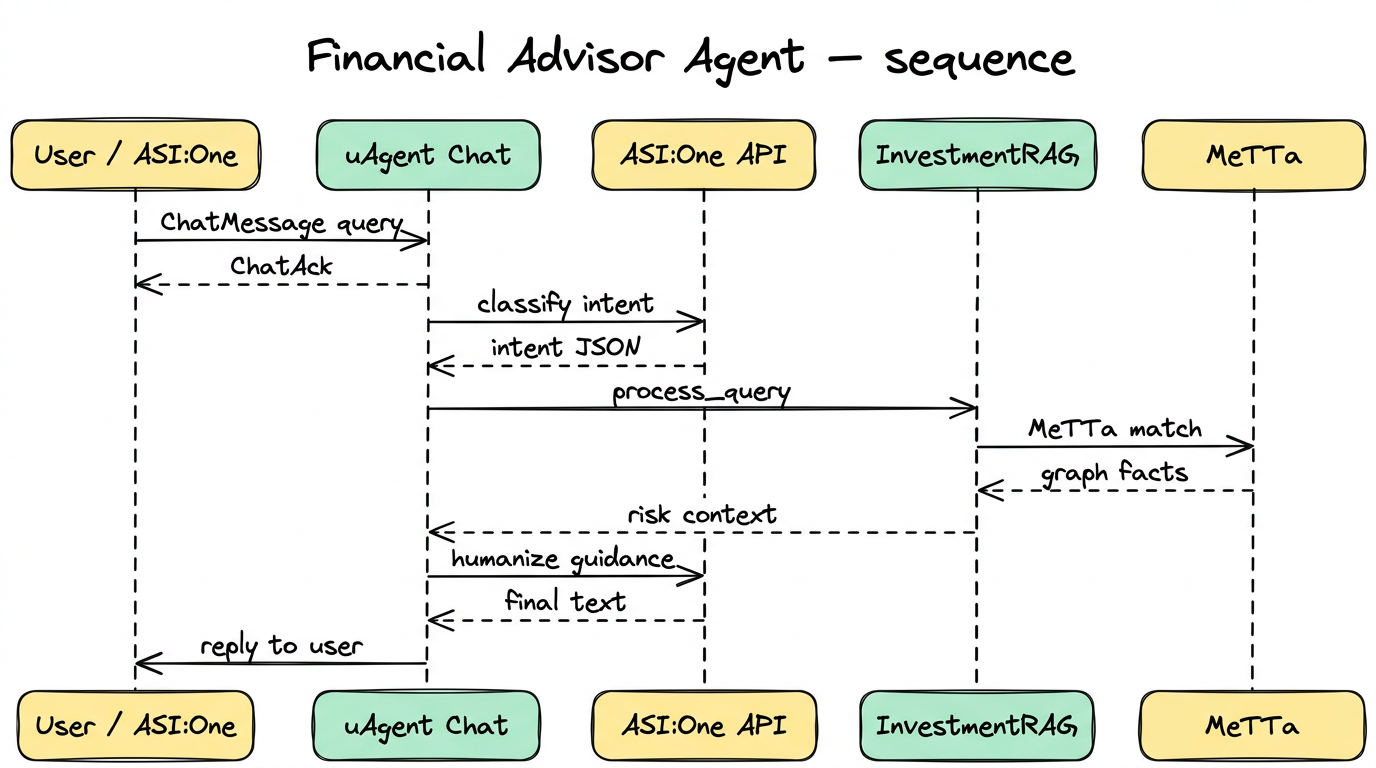
The code pipeline (ASI:One chat does not classify intent for you):
flowchart LR
  user[User or ASI:One chat]
  handler[Chat Protocol handler]
  llm[Agent LLM: intent plus keyword]
  lookup[MeTTa knowledge lookup]
  humanize[Humanize plus disclaimer]
  user --> handler --> llm --> lookup --> humanize --> user
Alt text: User or ASI:One sends chat text to the Chat Protocol handler. The agent LLM classifies intent and a keyword, MeTTa looks up the toy graph, then the agent humanizes the answer and sends a disclaimer-prefixed reply.
Architecture pipeline: User / ASI:One Chat → Chat Protocol handler → agent LLM classifies intent + keyword → MeTTa knowledge lookup (not vector RAG) → humanized reply with disclaimer → User.
Core Integration Concepts
1. MeTTa Knowledge Graph Structure
MeTTa organizes knowledge as atoms in logical spaces. Use one convention: risk profiles, investment types, age buckets, goals, and FAQ keys as S(...); free-text returns, risk notes, allocations, and FAQ answers as ValueAtom. Multi-word names use underscores (emergency_fund, dividend_stocks), never raw spaces or parentheses inside query interpolation.
from hyperon import MeTTa, E, S, ValueAtom

metta = MeTTa()

metta.space().add_atom(E(S("risk_profile"), S("conservative"), S("bonds")))
metta.space().add_atom(
    E(S("expected_return"), S("bonds"), ValueAtom("illustrative 3-5% annually (toy range)"))
)
metta.space().add_atom(
    E(S("faq"), S("amount_to_invest"), ValueAtom("Toy tip: 10-20% of income after an emergency fund."))
)
Key MeTTa Elements:
- E (Expression): Creates logical expressions
- S (Symbol): Represents symbolic atoms (profiles, investment types, FAQ keys)
- ValueAtom: Stores string values (return ranges, allocation text, FAQ answers)
- Space: Container where atoms are stored and queried
2. Pattern Matching and Querying
# Query syntax: !(match &self (relation subject $variable) $variable)
query_str = '!(match &self (risk_profile conservative $investment) $investment)'
results = metta.run(query_str)
# Results include bonds, dividend_stocks, savings_accounts for the toy graph
Query Components:
&self: References the current space$variable: Pattern matching variables that capture results!(match ...): Query syntax for pattern matching
Never interpolate unsanitized user/LLM text into MeTTa. Only simple [a-z0-9_]+ symbols are allowed.
3. uAgent Chat Protocol Integration
The following is an excerpt. Full Protocol construction is in agent.py. process_query returns a dict; send the humanized_answer string (plus disclaimer), not the dict.
from uagents_core.contrib.protocols.chat import (
    ChatMessage,
    ChatAcknowledgement,
    TextContent,
    chat_protocol_spec,
)

@chat_proto.on_message(ChatMessage)
async def handle_message(ctx: Context, sender: str, msg: ChatMessage):
    response = process_query(user_query, rag, llm)
    answer = response.get("humanized_answer", "I could not process that query.")
    await ctx.send(sender, create_text_chat(answer))
mailbox=True on Agent(...) is the Agentverse mailbox flag (an inbox so a local agent stays reachable). Do not import mailbox — that is Python's stdlib email-mailbox module and is unused here.
publish_agent_details=True publishes the agent's profile/details to Agentverse when the mailbox connects. Use it for discoverable demos; turn it off if you do not want the profile updated automatically.
4. Knowledge lookup (not vector RAG)
InvestmentRAG in this sample is a MeTTa retriever: pattern-match on the toy graph, then an LLM humanizes the result. It does not use embeddings or document RAG. The class name is historical; treat it as knowledge lookup. Dynamic graph writes from LLM guesses are off unless LEARN=1 is set (unsafe for anything beyond a local experiment).
Core Components
agent.py: Main uAgent with Chat Protocolmetta/knowledge.py: Toy MeTTa graph (illustrative US-centric teaching data — not market facts)metta/investment_rag.py: MeTTa lookup helpersmetta/utils.py: Intent classification and query processing
Implementation Guide
Step 1: Define Your Knowledge Domain
Create metta/knowledge.py. Seed edges use symbols for investment types under risk_profile, and ValueAtom for free-text returns, risk notes, allocations, strategies, sector examples, mistakes, and FAQs. FAQ keys must match query_faq (not the raw user sentence).
from hyperon import MeTTa, E, S, ValueAtom


def initialize_investment_knowledge(metta: MeTTa):
    """Toy graph for the tutorial. Not financial advice or market data."""
    # Risk profile → investment types (symbols)
    metta.space().add_atom(E(S("risk_profile"), S("conservative"), S("bonds")))
    metta.space().add_atom(E(S("risk_profile"), S("conservative"), S("dividend_stocks")))
    metta.space().add_atom(E(S("risk_profile"), S("conservative"), S("savings_accounts")))
    metta.space().add_atom(E(S("risk_profile"), S("moderate"), S("index_funds")))
    metta.space().add_atom(E(S("risk_profile"), S("moderate"), S("etfs")))
    metta.space().add_atom(E(S("risk_profile"), S("moderate"), S("real_estate")))
    metta.space().add_atom(E(S("risk_profile"), S("aggressive"), S("growth_stocks")))
    metta.space().add_atom(E(S("risk_profile"), S("aggressive"), S("cryptocurrency")))
    metta.space().add_atom(E(S("risk_profile"), S("aggressive"), S("options")))

    # Investment → illustrative return ranges (not forecasts)
    metta.space().add_atom(
        E(S("expected_return"), S("bonds"), ValueAtom("illustrative 3-5% annually (toy range)"))
    )
    metta.space().add_atom(
        E(
            S("expected_return"),
            S("dividend_stocks"),
            ValueAtom("illustrative 5-7% annually (toy range)"),
        )
    )
    metta.space().add_atom(
        E(
            S("expected_return"),
            S("index_funds"),
            ValueAtom("illustrative 6-10% annually (toy range)"),
        )
    )
    metta.space().add_atom(
        E(S("expected_return"), S("etfs"), ValueAtom("illustrative 5-12% annually (toy range)"))
    )
    metta.space().add_atom(
        E(
            S("expected_return"),
            S("growth_stocks"),
            ValueAtom("illustrative 8-15% annually (toy range)"),
        )
    )
    metta.space().add_atom(
        E(
            S("expected_return"),
            S("cryptocurrency"),
            ValueAtom("illustrative: highly volatile (toy label)"),
        )
    )
    metta.space().add_atom(
        E(
            S("expected_return"),
            S("savings_accounts"),
            ValueAtom("illustrative 1-2% annually (toy range)"),
        )
    )
    metta.space().add_atom(
        E(
            S("expected_return"),
            S("real_estate"),
            ValueAtom("illustrative 4-8% annually (toy range)"),
        )
    )
    metta.space().add_atom(
        E(
            S("expected_return"),
            S("options"),
            ValueAtom("illustrative: high risk, leveraged (toy label)"),
        )
    )

    # Investment → risk notes (softened; US-centric toy wording)
    metta.space().add_atom(
        E(S("risk_level"), S("bonds"), ValueAtom("typically lower volatility in this toy graph"))
    )
    metta.space().add_atom(
        E(
            S("risk_level"),
            S("dividend_stocks"),
            ValueAtom("low-moderate risk label in this toy graph"),
        )
    )
    metta.space().add_atom(
        E(S("risk_level"), S("index_funds"), ValueAtom("moderate risk, diversified (toy label)"))
    )
    metta.space().add_atom(
        E(S("risk_level"), S("etfs"), ValueAtom("low-moderate risk, liquid (toy label)"))
    )
    metta.space().add_atom(
        E(S("risk_level"), S("growth_stocks"), ValueAtom("higher risk label in this toy graph"))
    )
    metta.space().add_atom(
        E(
            S("risk_level"),
            S("cryptocurrency"),
            ValueAtom("very high risk / volatility (toy label)"),
        )
    )
    metta.space().add_atom(
        E(
            S("risk_level"),
            S("savings_accounts"),
            ValueAtom(
                "often treated as low risk in teaching examples; "
                "deposit insurance rules vary by country (US FDIC is one example only)"
            ),
        )
    )
    metta.space().add_atom(
        E(S("risk_level"), S("real_estate"), ValueAtom("moderate risk label (toy)"))
    )
    metta.space().add_atom(
        E(S("risk_level"), S("options"), ValueAtom("very high risk / leveraged (toy label)"))
    )

    # Age → simplified teaching allocations only (not advice)
    metta.space().add_atom(
        E(
            S("age_allocation"),
            S("20s"),
            ValueAtom("teaching example only: 80% stocks, 20% bonds"),
        )
    )
    metta.space().add_atom(
        E(
            S("age_allocation"),
            S("30s"),
            ValueAtom("teaching example only: 70% stocks, 30% bonds"),
        )
    )
    metta.space().add_atom(
        E(
            S("age_allocation"),
            S("40s"),
            ValueAtom("teaching example only: 60% stocks, 40% bonds"),
        )
    )
    metta.space().add_atom(
        E(
            S("age_allocation"),
            S("50s"),
            ValueAtom("teaching example only: 50% stocks, 50% bonds"),
        )
    )
    metta.space().add_atom(
        E(
            S("age_allocation"),
            S("60s"),
            ValueAtom("teaching example only: 40% stocks, 60% bonds"),
        )
    )

    # Goals → strategies
    metta.space().add_atom(
        E(
            S("goal_strategy"),
            S("retirement"),
            ValueAtom("toy: diversified index funds; retirement-account contributions"),
        )
    )
    metta.space().add_atom(
        E(
            S("goal_strategy"),
            S("emergency_fund"),
            ValueAtom("toy: high-yield savings / money market style cash buffer"),
        )
    )
    metta.space().add_atom(
        E(
            S("goal_strategy"),
            S("house_down_payment"),
            ValueAtom("toy: short-duration cash / short-term bonds"),
        )
    )
    metta.space().add_atom(
        E(
            S("goal_strategy"),
            S("wealth_building"),
            ValueAtom("toy: growth-oriented diversified equity exposure"),
        )
    )
    metta.space().add_atom(
        E(
            S("goal_strategy"),
            S("passive_income"),
            ValueAtom("toy: dividend stocks / bonds style examples"),
        )
    )

    # Sector → illustrative example companies (not current top performers)
    metta.space().add_atom(
        E(
            S("sector_stocks"),
            S("technology"),
            ValueAtom("illustrative names only: Apple, Microsoft, Google"),
        )
    )
    metta.space().add_atom(
        E(
            S("sector_stocks"),
            S("healthcare"),
            ValueAtom("illustrative names only: Johnson & Johnson, Pfizer"),
        )
    )
    metta.space().add_atom(
        E(
            S("sector_stocks"),
            S("finance"),
            ValueAtom("illustrative names only: JPMorgan Chase, Berkshire Hathaway"),
        )
    )
    metta.space().add_atom(
        E(
            S("sector_stocks"),
            S("energy"),
            ValueAtom("illustrative names only: ExxonMobil, Chevron"),
        )
    )

    # Common mistakes
    metta.space().add_atom(
        E(
            S("mistake"),
            S("timing_market"),
            ValueAtom("toy warning: avoid trying to time peaks and valleys"),
        )
    )
    metta.space().add_atom(
        E(
            S("mistake"),
            S("lack_diversification"),
            ValueAtom("toy warning: don't put all money in one stock or sector"),
        )
    )
    metta.space().add_atom(
        E(
            S("mistake"),
            S("emotional_trading"),
            ValueAtom("toy warning: avoid panic selling or FOMO buying"),
        )
    )
    metta.space().add_atom(
        E(
            S("mistake"),
            S("high_fees"),
            ValueAtom("toy warning: watch expensive product fees"),
        )
    )

    # FAQ keys must match query_faq (not the raw user sentence)
    metta.space().add_atom(
        E(
            S("faq"),
            S("amount_to_invest"),
            ValueAtom(
                "Toy tip only: some teaching materials mention 10-20% of income "
                "after an emergency fund. Not personalized advice."
            ),
        )
    )
    metta.space().add_atom(
        E(
            S("faq"),
            S("when_to_start"),
            ValueAtom(
                "Toy tip only: starting early is often cited for compounding demos. "
                "Not personalized advice."
            ),
        )
    )
    metta.space().add_atom(
        E(
            S("faq"),
            S("diversification"),
            ValueAtom(
                "Toy definition: spreading exposure across assets to reduce "
                "single-name risk. Not personalized advice."
            ),
        )
    )
    metta.space().add_atom(
        E(
            S("faq"),
            S("debt_first"),
            ValueAtom(
                "Toy tip only: high-interest debt is often prioritized before "
                "investing in teaching examples. Not personalized advice."
            ),
        )
    )
    metta.space().add_atom(
        E(
            S("faq"),
            S("hi"),
            ValueAtom("Hello! Ask about risk profiles, returns, allocation, or goals in this toy demo."),
        )
    )
Worked FAQ example: user says How much should I invest? → classifier keyword amount_to_invest → graph key amount_to_invest → seeded answer.
Expected keyword forms (normalize before MeTTa): conservative / moderate / aggressive; age buckets 20s–60s (map “30-year-old” → 30s); goals retirement, emergency_fund; sectors technology; FAQ keys above.
Limitation: the classifier extracts one keyword. Sample queries below use a single focus term.
Step 2: Implement MeTTa lookup
Create metta/investment_rag.py:
import re
from hyperon import MeTTa, E, S, ValueAtom

SYMBOL_PATTERN = re.compile(r"^[a-z0-9_]+$")

# Map common natural-language fragments to seeded keys
KEYWORD_ALIASES = {
    "30-year-old": "30s",
    "30_year_old": "30s",
    "thirty": "30s",
    "20-year-old": "20s",
    "40-year-old": "40s",
    "50-year-old": "50s",
    "60-year-old": "60s",
    "emergency fund": "emergency_fund",
    "down payment": "house_down_payment",
    "how_much_should_i_invest": "amount_to_invest",
    "when_should_i_start_investing": "when_to_start",
    "what_is_diversification": "diversification",
    "should_i_pay_off_debt_first": "debt_first",
}


def to_symbol(token: str):
    """Encode multi-word names; reject tokens that would break MeTTa."""
    if token is None:
        return None
    raw = str(token).strip().strip('"').lower().replace("'", "").replace("\u2019", "")
    if raw in KEYWORD_ALIASES:
        return KEYWORD_ALIASES[raw]
    symbol = raw.replace(" ", "_").replace("-", "_")
    if symbol in KEYWORD_ALIASES:
        return KEYWORD_ALIASES[symbol]
    if not SYMBOL_PATTERN.fullmatch(symbol):
        return None
    return symbol


def atom_to_str(atom) -> str:
    """Parse both Symbol and ValueAtom results."""
    try:
        obj = atom.get_object()
        if obj is not None and hasattr(obj, "value"):
            return str(obj.value)
    except Exception:
        pass
    return str(atom).strip('"')


class InvestmentRAG:
    """MeTTa knowledge lookup (not embedding / vector RAG)."""

    def __init__(self, metta_instance: MeTTa):
        self.metta = metta_instance

    def _run_match(self, relation: str, subject: str):
        symbol = to_symbol(subject)
        if not symbol:
            return []
        query_str = f"!(match &self ({relation} {symbol} $x) $x)"
        results = self.metta.run(query_str)
        if not results:
            return []
        values = []
        for row in results:
            if row and len(row) > 0:
                values.append(atom_to_str(row[0]))
        return list(dict.fromkeys(values))

    def query_risk_profile(self, risk_profile):
        return self._run_match("risk_profile", risk_profile)

    def get_expected_return(self, investment):
        return self._run_match("expected_return", investment)

    def get_risk_level(self, investment):
        return self._run_match("risk_level", investment)

    def get_age_allocation(self, age_group):
        return self._run_match("age_allocation", age_group)

    def get_goal_strategy(self, goal):
        return self._run_match("goal_strategy", goal)

    def query_sector_stocks(self, sector):
        return self._run_match("sector_stocks", sector)

    def get_mistake_warning(self, mistake):
        return self._run_match("mistake", mistake)

    def query_faq(self, question_or_key):
        key = to_symbol(question_or_key)
        if not key:
            return None
        results = self._run_match("faq", key)
        return results[0] if results else None

    def add_knowledge(self, relation_type, subject, object_value):
        """Same atom conventions as seed data. Used only when LEARN=1."""
        rel = to_symbol(relation_type)
        subj = to_symbol(subject)
        if not rel or not subj or object_value is None:
            return "Skipped invalid knowledge"

        if rel == "risk_profile":
            # One atom per investment type symbol (matches seed)
            parts = [
                to_symbol(p)
                for p in str(object_value).replace(",", " ").split()
                if to_symbol(p)
            ]
            if not parts:
                return "Skipped invalid investment symbols"
            for obj in parts:
                self.metta.space().add_atom(E(S(rel), S(subj), S(obj)))
            return f"Added {rel}: {subj} -> {', '.join(parts)}"

        atom_obj = ValueAtom(str(object_value))
        self.metta.space().add_atom(E(S(rel), S(subj), atom_obj))
        return f"Added {rel}: {subj} -> {object_value}"
Key Methods:
query_risk_profile(): Investment type symbols for a profileget_expected_return()/get_risk_level(): Illustrative ValueAtom textget_age_allocation()/get_goal_strategy(): Teaching examplesquery_sector_stocks(): Illustrative company names (not live performance)query_faq(): FAQ by stable key (amount_to_invest,hi), not the raw sentenceadd_knowledge(): Same atom types as seed data (used only whenLEARN=1)
Step 3: Query processing
Create metta/utils.py. Fallback if not prompt: sits at function scope after all intent branches. Default path does not write LLM output into the graph.
create_completion uses a smaller max_tokens (about 200) for short JSON intent classification and a larger budget (about 300–800) when humanizing a full reply — intent only needs a tiny JSON object; answers need room for the disclaimer and explanation.
import json
import os

from openai import OpenAI

from .investment_rag import InvestmentRAG, to_symbol

DISCLAIMER = (
    "Not financial advice. This is a toy MeTTa demo for education only, "
    "not personalized recommendations or a substitute for a licensed advisor."
)
LEARN = os.getenv("LEARN") == "1"


class LLM:
    def __init__(self, api_key):
        self.client = OpenAI(
            api_key=api_key,
            base_url="https://api.asi1.ai/v1",
        )

    def create_completion(self, prompt, max_tokens=800):
        completion = self.client.chat.completions.create(
            messages=[{"role": "user", "content": prompt}],
            model="asi1",
            max_tokens=max_tokens,
        )
        return completion.choices[0].message.content


def get_intent_and_keyword(query, llm):
    """Agent-side ASI:One call: classify intent and extract one keyword."""
    prompt = (
        f"Given the investment query: '{query}'\n"
        "Classify the intent as one of: 'risk_profile', 'investment_advice', "
        "'returns', 'allocation', 'goal', 'sector', 'mistake', 'faq', or 'unknown'.\n"
        "Extract one keyword as a snake_case graph key.\n"
        "Age phrases like '30-year-old' must become '30s' (also 20s/40s/50s/60s).\n"
        "Goals: retirement, emergency_fund, house_down_payment, wealth_building, passive_income.\n"
        "FAQs: amount_to_invest, when_to_start, diversification, debt_first; greetings → hi.\n"
        "Risk profiles: conservative, moderate, aggressive.\n"
        "Return *only* JSON:\n"
        '{ "intent": "<classified_intent>", "keyword": "<extracted_keyword>" }'
    )
    response = llm.create_completion(prompt, max_tokens=200)
    try:
        cleaned = response.strip()
        if cleaned.startswith("```"):
            cleaned = "\n".join(cleaned.split("\n")[1:])
        if cleaned.endswith("```"):
            cleaned = "\n".join(cleaned.split("\n")[:-1])
        result = json.loads(cleaned.strip())
        return result["intent"], result.get("keyword")
    except (json.JSONDecodeError, KeyError):
        return "unknown", None


def generate_knowledge_response(query, intent, keyword, llm):
    """Optional LLM guess. Do not persist unless LEARN=1."""
    if intent == "risk_profile":
        prompt = (
            f"Query: '{query}'\n"
            f"Risk profile '{keyword}' is missing from the toy graph. Suggest 2-3 "
            f"snake_case investment type tokens (e.g. bonds index_funds). Return only those tokens."
        )
    elif intent == "investment_advice":
        prompt = (
            f"Query: '{query}'\n"
            f"No graph notes for '{keyword}'. Give a one-sentence educational overview "
            f"(not personalized advice). Return only that text."
        )
    elif intent == "returns":
        prompt = (
            f"Query: '{query}'\n"
            f"No illustrative return range for '{keyword}'. Suggest one short toy range "
            f"labeled as illustrative only. Return only that text."
        )
    elif intent == "allocation":
        prompt = (
            f"Query: '{query}'\n"
            f"No teaching allocation for '{keyword}'. Suggest one simplified stocks/bonds "
            f"example labeled teaching-only. Return only that text."
        )
    elif intent == "goal":
        prompt = (
            f"Query: '{query}'\n"
            f"No strategy for '{keyword}'. Suggest one short educational approach. Return only that text."
        )
    elif intent == "sector":
        prompt = (
            f"Query: '{query}'\n"
            f"No illustrative names for '{keyword}'. Suggest a few example companies "
            f"(not performance claims). Return only a short list."
        )
    elif intent == "mistake":
        prompt = (
            f"Query: '{query}'\n"
            f"No warning for '{keyword}'. Give one short educational caution. Return only that text."
        )
    elif intent == "faq":
        prompt = (
            f"Query: '{query}'\n"
            "Provide a concise educational overview and remind the user this is not financial advice. "
            "Return only the answer."
        )
    else:
        return None
    return llm.create_completion(prompt, max_tokens=200)


def process_query(query, rag: InvestmentRAG, llm: LLM):
    intent, keyword = get_intent_and_keyword(query, llm)
    keyword = to_symbol(keyword) if keyword else None
    prompt = ""

    if intent == "faq":
        faq_key = keyword or to_symbol(query)
        faq_answer = rag.query_faq(faq_key) if faq_key else None
        if faq_answer:
            prompt = (
                f"Query: '{query}'\n"
                f"FAQ Answer: '{faq_answer}'\n"
                "Humanize with a friendly educational tone. Keep not-financial-advice meaning."
            )
        else:
            new_answer = generate_knowledge_response(query, intent, keyword, llm)
            if LEARN and faq_key and new_answer:
                rag.add_knowledge("faq", faq_key, new_answer)
            prompt = (
                f"Query: '{query}'\n"
                f"FAQ Answer: '{new_answer}'\n"
                "Humanize with a friendly educational tone. This is not financial advice."
            )
    elif intent == "risk_profile" and keyword:
        investments = rag.query_risk_profile(keyword)
        if not investments:
            investment_types = generate_knowledge_response(query, intent, keyword, llm)
            if LEARN and investment_types:
                rag.add_knowledge("risk_profile", keyword, investment_types)
            prompt = (
                f"Query: '{query}'\n"
                f"Risk Profile: {keyword}\n"
                f"Suitable Investments (unverified LLM suggestion, not a graph fact): {investment_types}\n"
                "Be explicit this is a toy educational overview, not recommendations."
            )
        else:
            investment_details = []
            for investment in investments:
                returns = rag.get_expected_return(investment)
                risks = rag.get_risk_level(investment)
                investment_details.append(
                    {
                        "type": investment,
                        "returns": returns[0] if returns else "N/A",
                        "risks": risks[0] if risks else "N/A",
                    }
                )
            prompt = (
                f"Query: '{query}'\n"
                f"Risk Profile: {keyword}\n"
                f"Investment Options (toy graph): {investment_details}\n"
                "Give an educational overview only. Label returns as illustrative ranges."
            )
    elif intent == "returns" and keyword:
        returns = rag.get_expected_return(keyword)
        risks = rag.get_risk_level(keyword)
        if not returns:
            return_info = generate_knowledge_response(query, intent, keyword, llm)
            if LEARN and return_info:
                rag.add_knowledge("expected_return", keyword, return_info)
            prompt = (
                f"Query: '{query}'\n"
                f"Investment: {keyword}\n"
                f"Expected Returns (unverified LLM suggestion): {return_info}\n"
                "Say this is not a forecast and not from the verified toy graph."
            )
        else:
            prompt = (
                f"Query: '{query}'\n"
                f"Investment: {keyword}\n"
                f"Illustrative return ranges (toy graph, not forecasts): {', '.join(returns)}\n"
                f"Risk notes: {', '.join(risks) if risks else 'Not specified'}\n"
                "Explain as educational ranges only."
            )
    elif intent == "allocation" and keyword:
        allocation = rag.get_age_allocation(keyword)
        if not allocation:
            allocation_advice = generate_knowledge_response(query, intent, keyword, llm)
            if LEARN and allocation_advice:
                rag.add_knowledge("age_allocation", keyword, allocation_advice)
            prompt = (
                f"Query: '{query}'\n"
                f"Age Group: {keyword}\n"
                f"Allocation (unverified LLM suggestion): {allocation_advice}\n"
                "Label as a simplified teaching example only."
            )
        else:
            prompt = (
                f"Query: '{query}'\n"
                f"Age Group: {keyword}\n"
                f"Teaching allocation example: {', '.join(allocation)}\n"
                "Explain as a simplified classroom example, not advice."
            )
    elif intent == "goal" and keyword:
        strategies = rag.get_goal_strategy(keyword)
        if not strategies:
            strategy = generate_knowledge_response(query, intent, keyword, llm)
            if LEARN and strategy:
                rag.add_knowledge("goal_strategy", keyword, strategy)
            prompt = (
                f"Query: '{query}'\n"
                f"Investment Goal: {keyword}\n"
                f"Strategy (unverified LLM suggestion): {strategy}\n"
                "Educational overview only."
            )
        else:
            prompt = (
                f"Query: '{query}'\n"
                f"Investment Goal: {keyword}\n"
                f"Toy strategies: {', '.join(strategies)}\n"
                "Educational overview only."
            )
    elif intent == "sector" and keyword:
        stocks = rag.query_sector_stocks(keyword)
        if not stocks:
            sector_info = generate_knowledge_response(query, intent, keyword, llm)
            if not sector_info:
                sector_info = (
                    "No specific names generated; consider diversified sector funds in real life "
                    "(this demo is not advice)."
                )
            elif LEARN:
                rag.add_knowledge("sector_stocks", keyword, sector_info)
            prompt = (
                f"Query: '{query}'\n"
                f"Sector: {keyword}\n"
                f"Illustrative names: {sector_info}\n"
                "Do not claim current performance rankings."
            )
        else:
            prompt = (
                f"Query: '{query}'\n"
                f"Sector: {keyword}\n"
                f"Illustrative example companies (not top performers / not recommendations): "
                f"{', '.join(stocks)}\n"
                "Educational naming only."
            )
    elif intent == "investment_advice" and keyword:
        exp = rag.get_expected_return(keyword)
        risks = rag.get_risk_level(keyword)
        if exp or risks:
            prompt = (
                f"Query: '{query}'\n"
                f"Investment type: {keyword}\n"
                f"Illustrative returns (toy graph): {', '.join(exp) if exp else 'N/A'}\n"
                f"Risk notes (toy graph): {', '.join(risks) if risks else 'N/A'}\n"
                "Educational overview only; not a recommendation."
            )
        else:
            advice = generate_knowledge_response(query, intent, keyword, llm)
            if not advice:
                advice = (
                    "Consider diversified, low-cost options aligned with your horizon in real life; "
                    "consult a licensed professional for personal advice."
                )
            # investment_advice does not invent new graph edges unless LEARN=1
            # and you choose to store expected_return text for consistency
            if LEARN and advice:
                rag.add_knowledge("expected_return", keyword, advice)
            prompt = (
                f"Query: '{query}'\n"
                f"Investment type: {keyword}\n"
                f"Guidance: {advice}\n"
                "Educational overview only; not a recommendation."
            )
    elif intent == "mistake" and keyword:
        warnings = rag.get_mistake_warning(keyword)
        if warnings:
            wtext = ", ".join(warnings)
        else:
            wtext = generate_knowledge_response(query, intent, keyword, llm)
            if not wtext:
                wtext = (
                    "Prioritize diversification, discipline, and awareness of fees and emotions "
                    "(toy teaching note)."
                )
            elif LEARN:
                rag.add_knowledge("mistake", keyword, wtext)
        prompt = (
            f"Query: '{query}'\n"
            f"Topic / behavior: {keyword}\n"
            f"Warning(s): {wtext}\n"
            "Explain clearly as educational caution, not personalized advice."
        )

    if not prompt:
        prompt = (
            f"Query: '{query}'\n"
            "No specific info found in the toy graph. Offer general educational assistance "
            "and suggest consulting a licensed financial professional."
        )

    prompt += (
        f"\nAlways start the answer with: {DISCLAIMER}\n"
        "Then give the helpful educational content. Do not invent personalized buy/sell orders."
    )
    response = llm.create_completion(prompt, max_tokens=800)
    text = (response or "").strip()
    if DISCLAIMER.lower() not in text.lower():
        text = f"{DISCLAIMER}\n\n{text}"
    return {"selected_question": query, "humanized_answer": text}
Intent Classification (runs in the agent, after Chat Protocol receives text):
- risk_profile: keyword → investment type symbols in the toy graph
- returns / investment_advice: illustrative return / risk notes
- allocation: age keys
20s…60s(teaching examples) - goal / sector / mistake: keyed strategies, illustrative names, warnings
- faq: keyed FAQs (
amount_to_invest,when_to_start,diversification,debt_first,hi)
Step 4: Configure Agent
Create agent.py at the project root (not inside metta/):
from datetime import datetime, timezone
from uuid import uuid4
import os
import sys

from dotenv import load_dotenv
from uagents import Context, Protocol, Agent
from hyperon import MeTTa

from uagents_core.contrib.protocols.chat import (
    ChatAcknowledgement,
    ChatMessage,
    EndSessionContent,
    StartSessionContent,
    TextContent,
    chat_protocol_spec,
)

from metta.investment_rag import InvestmentRAG
from metta.knowledge import initialize_investment_knowledge
from metta.utils import LLM, process_query, DISCLAIMER

load_dotenv()

api_key = os.getenv("ASI_ONE_API_KEY")
agent_seed = os.getenv("AGENT_SEED")

if not api_key:
    print("Missing ASI_ONE_API_KEY. Create a key at https://asi1.ai/dashboard/api-keys and put it in .env")
    sys.exit(1)

if not agent_seed:
    print("Missing AGENT_SEED. Set a unique local seed in .env (do not commit secrets).")
    sys.exit(1)

agent = Agent(
    name="Financial Investment Advisor",
    seed=agent_seed,
    port=8008,
    mailbox=True,
    publish_agent_details=True,
)


def create_text_chat(text: str, end_session: bool = False) -> ChatMessage:
    content = [TextContent(type="text", text=text)]
    if end_session:
        content.append(EndSessionContent(type="end-session"))
    return ChatMessage(
        timestamp=datetime.now(timezone.utc),
        msg_id=uuid4(),
        content=content,
    )


metta = MeTTa()
initialize_investment_knowledge(metta)
rag = InvestmentRAG(metta)
llm = LLM(api_key=api_key)

chat_proto = Protocol(spec=chat_protocol_spec)


@chat_proto.on_message(ChatMessage)
async def handle_message(ctx: Context, sender: str, msg: ChatMessage):
    ctx.storage.set(str(ctx.session), sender)
    await ctx.send(
        sender,
        ChatAcknowledgement(
            timestamp=datetime.now(timezone.utc),
            acknowledged_msg_id=msg.msg_id,
        ),
    )

    for item in msg.content:
        if isinstance(item, StartSessionContent):
            ctx.logger.info(f"Got a start session message from {sender}")
            continue
        elif isinstance(item, TextContent):
            user_query = item.text.strip()
            ctx.logger.info(f"Got an investment query from {sender}: {user_query}")
            try:
                response = process_query(user_query, rag, llm)
                answer_text = response.get(
                    "humanized_answer",
                    f"{DISCLAIMER}\n\nI could not process your query.",
                )
                await ctx.send(sender, create_text_chat(answer_text))
            except Exception as e:
                ctx.logger.error(f"Error processing investment query: {e}")
                await ctx.send(
                    sender,
                    create_text_chat(
                        f"{DISCLAIMER}\n\nI hit an error processing that query. Please try again."
                    ),
                )
        else:
            ctx.logger.info(f"Got unexpected content from {sender}")


@chat_proto.on_message(ChatAcknowledgement)
async def handle_ack(ctx: Context, sender: str, msg: ChatAcknowledgement):
    ctx.logger.info(
        f"Got an acknowledgement from {sender} for {msg.acknowledged_msg_id}"
    )


agent.include(chat_proto, publish_manifest=True)

if __name__ == "__main__":
    agent.run()
Agent Features:
- Toy MeTTa lookup only — not a financial advisor product or personalized advice
- Every reply includes a not financial advice disclaimer
- Does not persist unverified LLM output into the graph unless
LEARN=1 - Agent LLM (ASI:One) classifies intent after Chat Protocol receives text
- Compatible with ASI:One via Chat Protocol and Agentverse mailbox (
mailbox=True)
Detailed Working (Step-by-Step)
- User sends a query through ASI:One chat (or Inspector chat).
- Chat Protocol handler receives
TextContent. - The agent calls ASI:One (
get_intent_and_keyword) to classify intent and one keyword. InvestmentRAGruns MeTTamatchqueries on the toy graph (knowledge lookup, not vector RAG).- Reply is humanized, disclaimer is prepended, and Chat Protocol sends a string (not a dict).
- Graph writes from LLM guesses happen only when
LEARN=1.
Testing and Deployment
Local Testing (mailbox)
Numbered steps matching current uAgents + Agentverse. See also Mailbox agents and uAgent creation.
-
Log in to Agentverse.
-
From
project/, with venv active and.envset:python3 agent.pyWindows:
py -3.10 agent.py. -
In the console, copy the inspector URL (it includes your agent address). Expected lines look like:
INFO: [Financial Investment Advisor]: Starting agent with address: agent1q...INFO: [Financial Investment Advisor]: Agent inspector available at https://agentverse.ai/inspect/?uri=http%3A//127.0.0.1%3A8008&address=agent1q...INFO: [Financial Investment Advisor]: Starting mailbox client for https://agentverse.aiINFO: [mailbox]: Successfully registered as mailbox agent in AgentverseIf you see
Missing ASI_ONE_API_KEY, stop and fix.env— the agent exits beforeagent.run(). -
Open the inspector URL while logged in. Choose Connect → Mailbox (Agentverse issues the mailbox token; you do not paste Python
import mailbox). -
Use Chat with Agent on the Inspector/profile, or continue to ASI:One below. Keep
agent.pyrunning.
Sample queries (aligned with seeded keys)
Hi→ FAQ keyhi(greeting)How much should I invest?→ FAQ keyamount_to_invest(seeded FAQ)I am a conservative investor, what should I invest in?→ risk profileconservative→bonds,dividend_stocks,savings_accountsWhat returns can I expect from index funds?→ illustrative ranges forindex_fundsHow should a 30-year-old allocate a portfolio?→ age key30s(teaching example)What strategy works best for retirement?→ goalretirementWhat are common investing mistakes to avoid?→ mistake keys such astiming_market/lack_diversification(one keyword per turn)
Query your agent from ASI:One
ASI:One discovers mailbox agents that are running, registered, and using Chat Protocol. README/handle tips: Searching agents. Chat UI: ASI:One Chat.
- Copy the agent address from the console (
agent1q...). Optionally set a handle on the Agentverse profile. - Open ASI:One, sign in with Google or the ASI:One wallet, and start a new chat.
- Toggle Agents so ASI:One can call Agentverse agents.
- Paste the address or
@handleand send a sample query such asI am a conservative investor, what should I invest in? - Expect a reply that starts with the not-financial-advice disclaimer and mentions toy graph options such as bonds / dividend_stocks / savings_accounts. The local console should log the incoming chat message.
Expected output
Startup (shape of logs; address is unique to your AGENT_SEED):
INFO:     [Financial Investment Advisor]: Starting agent with address: agent1q...
INFO:     [Financial Investment Advisor]: Agent inspector available at https://agentverse.ai/inspect/?uri=...
INFO:     [mailbox]: Successfully registered as mailbox agent in Agentverse
Example chat:
-
You:
How much should I invest? -
Agent: Starts with Not financial advice... then, from the toy FAQ key
amount_to_invest, gives the seeded educational tip (not a personalized plan). -
You:
I am a conservative investor, what should I invest in? -
Agent: Starts with the disclaimer, then lists toy-graph options like
bonds,dividend_stocks, andsavings_accountswith illustrative return/risk notes.
Notes
- Educational toy demo only — not personalized financial advice.
- Default path does not persist unverified LLM financial “facts”; set
LEARN=1only for local experiments. - For production usage, add compliance rules, disclosure controls, and policy guardrails.
- Sibling MeTTa samples: Medical Agent with MeTTa, Fetch.ai Knowledge Assistant with MeTTa.