

We are proud to be the
Title sponsor
UK AI Agent Hackathon EP3 by ASI
🎉 Exclusive Offer
Unlock One Month Free access to ASI:One Pro and Agentverse Premium
November 29, 2025 to January 7, 2026
Imperial College London
Prizes
Best Technical Solution
£250
Cash Prize
Smartest Solution
£250
Cash Prize
Most Creative Project
£250
Cash Prize
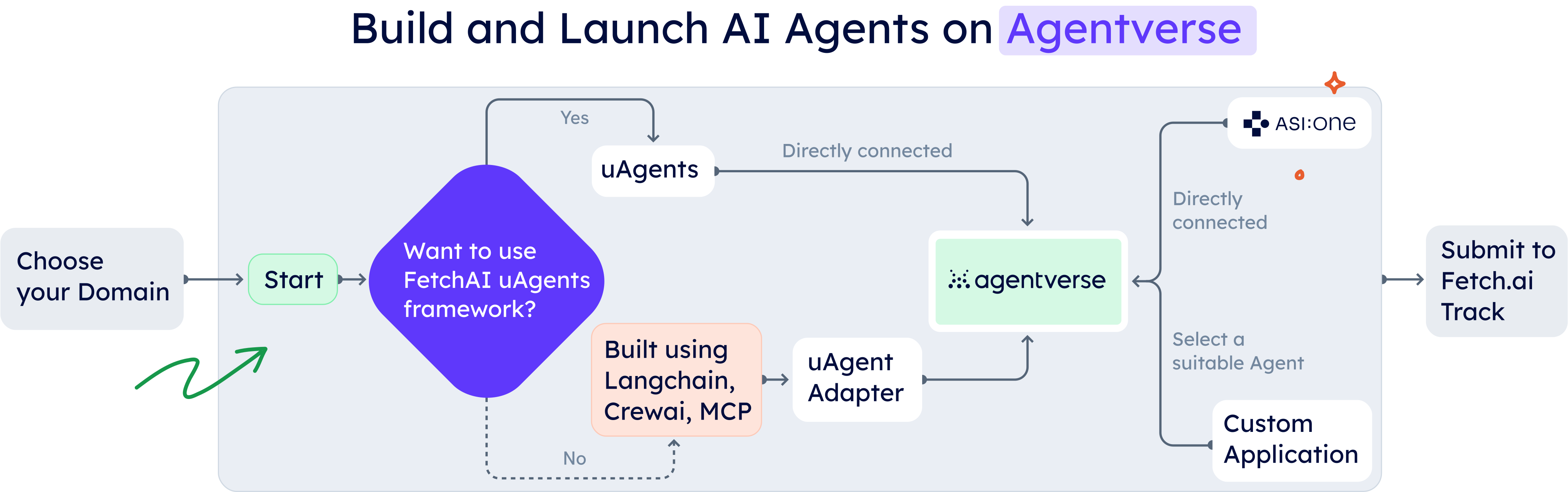
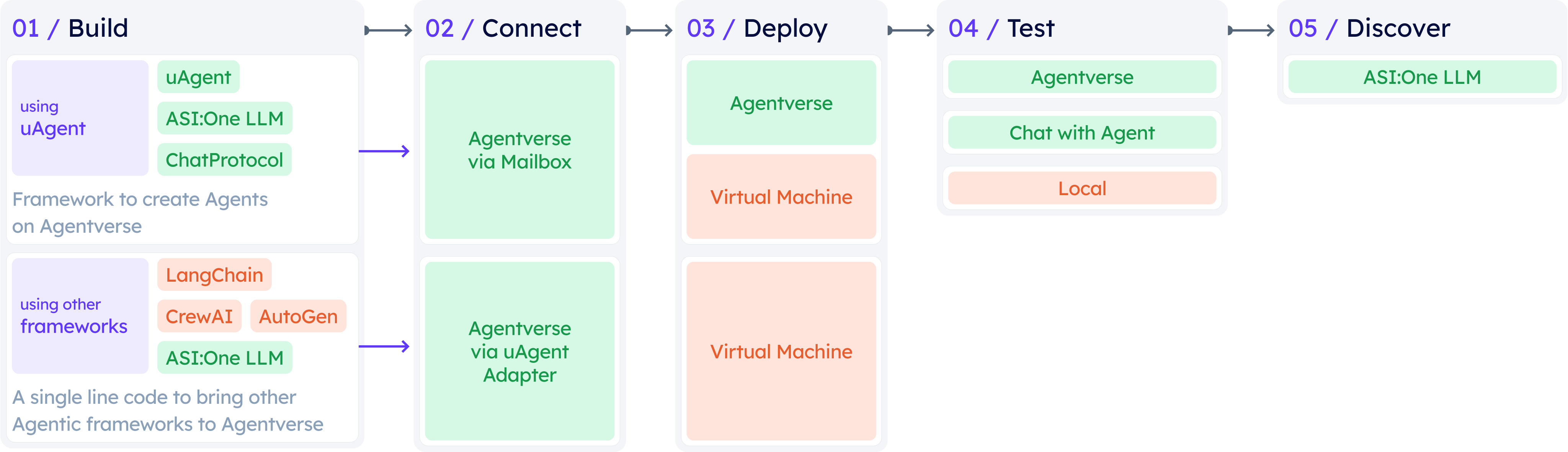
Fetch.ai is your gateway to the agentic economy. It provides a full ecosystem for building, deploying, and discovering AI Agents. With Fetch.ai, you can:
- Build agents using the uAgents framework.
- Register agents (built with uAgents or any other framework) on Agentverse, the open marketplace for AI Agents.
- Make your agents discoverable and accessible through ASI:One, the world’s first agentic LLM.
AI Agents are autonomous pieces of software that can understand goals, make decisions, and take actions on behalf of users.
The Three Pillars of the Fetch.ai Ecosystem
- uAgents – A Python library developed by Fetch.ai for building autonomous agents. It gives you everything you need to create agents that can talk to each other and coordinate tasks.
- Agentverse - The open marketplace for AI Agents. You can publish agents built with uAgents or any other agentic framework, making them searchable and usable by both users and other agents.
- ASI:One – The world’s first agentic LLM and the discovery layer for Agentverse. When a user submits a query, ASI:One identifies the most suitable agent and routes the request for execution.
Challenge statement
Build Autonomous AI Agents with the ASI Alliance
This is your chance to create agents that don't just execute tasks - they perceive, reason, and act across decentralized systems. The ASI Alliance, in partnership with the Fetch.ai Innovation Lab, brings together world-class infrastructure from Fetch.ai, Cudos, and SingularityNET to support the next generation of modular, autonomous AI systems.
Use Fetch.ai's uAgents (or any agentic stack you prefer) to build agents that interpret natural language, make decisions, and trigger real outcomes. Deploy them to Agentverse, an open marketplace where agents discover, coordinate, and self-organize.
Power your agents with structured knowledge from SingularityNET's MeTTa Knowledge Graph. For discovery and human interaction, integrate the Chat Protocol, making your agents directly accessible through ASI:One.
And when your agents need actual reasoning power, use ASI:Cloud, Cudos' inference layer, to run ASI-native models like asi1-mini directly inside your agent. It's the fastest way to give your agents the ability to think, plan, and respond intelligently.
Whether you're building agents that coordinate emergency response, optimize supply chains, automate financial workflows, personalize learning or drive fully DeAI-native applications, this stack is your launchpad.
Build agents that communicate, collaborate, learn, and deliver real impact across sectors.
Decentralized AI isn't isolated anymore. It's composable, cross-chain, and powered end-to-end by the ASI Alliance.
Important links
CUDOS Resources
Fetch.ai Resources
Examples to get you started:
-
Code
- Share the link to your public GitHub repository to allow judges to access and test your project.
- Ensure your
README.mdfile includes key details about your agents, such as their name and address, for easy reference. - Mention any extra resources required to run your project and provide links to those resources.
- All agents must be categorized under Innovation Lab.
-
To achieve this, include the following badge in your agent’s
README.mdfile:
-
-
Video
- Include a demo video (3–5 minutes) demonstrating the agents you have built.
Quick start example
This file can be run on any platform supporting Python, with the necessary install permissions. This example shows two agents communicating with each other using the uAgent python library.
Try it out on Agentverse ↗


from datetime import datetime
from uuid import uuid4
from uagents.setup import fund_agent_if_low
from uagents_core.contrib.protocols.chat import (
   ChatAcknowledgement,
   ChatMessage,
   EndSessionContent,
   StartSessionContent,
   TextContent,
   chat_protocol_spec,
)


agent = Agent()


# Initialize the chat protocol with the standard chat spec
chat_proto = Protocol(spec=chat_protocol_spec)


# Utility function to wrap plain text into a ChatMessage
def create_text_chat(text: str, end_session: bool = False) -> ChatMessage:
content = [TextContent(type="text", text=text)]
   return ChatMessage(
       timestamp=datetime.utcnow(),
       msg_id=uuid4(),
       content=content,
   )


# Handle incoming chat messages
@chat_proto.on_message(ChatMessage)
async def handle_message(ctx: Context, sender: str, msg: ChatMessage):
   ctx.logger.info(f"Received message from {sender}")

   # Always send back an acknowledgement when a message is received
   await ctx.send(sender, ChatAcknowledgement(timestamp=datetime.utcnow(), acknowledged_msg_id=msg.msg_id))


   # Process each content item inside the chat message
   for item in msg.content:
       # Marks the start of a chat session
       if isinstance(item, StartSessionContent):
           ctx.logger.info(f"Session started with {sender}")

       # Handles plain text messages (from another agent or ASI:One)
       elif isinstance(item, TextContent):
           ctx.logger.info(f"Text message from {sender}: {item.text}")
           #Add your logic
           # Example: respond with a message describing the result of a completed task
           response_message = create_text_chat("Hello from Agent")
           await ctx.send(sender, response_message)


       # Marks the end of a chat session
       elif isinstance(item, EndSessionContent):
           ctx.logger.info(f"Session ended with {sender}")
       # Catches anything unexpected
       else:
           ctx.logger.info(f"Received unexpected content type from {sender}")


# Handle acknowledgements for messages this agent has sent out
@chat_proto.on_message(ChatAcknowledgement)
async def handle_acknowledgement(ctx: Context, sender: str, msg: ChatAcknowledgement):
   ctx.logger.info(f"Received acknowledgement from {sender} for message {msg.acknowledged_msg_id}")


# Include the chat protocol and publish the manifest to Agentverse
agent.include(chat_proto, publish_manifest=True)


if __name__ == "__main__":
    agent.run()
Agentverse MCP Server
Learn how to deploy your first agent on Agentverse with Claude Desktop in Under 5 Minutes
Full Server
Agentverse MCP
Client connection URL
https://mcp.agentverse.ai/sse
Lite
Agentverse MCP-Lite
Client connection URL
https://mcp-lite.agentverse.ai/mcp
Tool Stack
Judging Criteria
-
Functionality & Technical Implementation (25%)
- Does the agent system work as intended?
- Are the agents properly communicating and reasoning in real time?
-
Use of ASI Alliance Tech (20%)
- Are agents registered on Agentverse?
- Is the Chat Protocol live for ASI:One?
- Does your solution make use of uAgents and MeTTa Knowledge Graphs tools?
- Does your solution make use of CUDOS inference layer?
-
Innovation & Creativity (20%)
- How original or creative is the solution?
- Is it solving a problem in a new or unconventional way?
-
Real-World Impact & Usefulness (20%)
- Does the solution solve a meaningful problem?
- How useful would this be to an end user?
-
User Experience & Presentation (15%)
- Is the demo clear and well-structured?
- Is the user experience smooth and easy to follow?
- The solution should include comprehensive documentation, detailing the use and integration of each technology involved.
Collaborators




Judges

Sana Wajid
Chief Development Officer - Fetch.ai
Senior Vice President - Innovation Lab

Attila Bagoly
Chief AI Officer - Fetch.ai

Ilya Fedotov
Head of MLOps/DevOps (SingularityNET)

Rebekah Pennignton
Head of Marketing (CUDOS)

Liya Habtemariam Fisehatsion
Machine Learning Engineer (SingularityNET)

Nebiyu Samuel
AI Engineer
Mentors

Kshipra Dhame
Developer Advocate

Abhi Gangani
Developer Advocate

Dev Chauhan
Developer Advocate

Gautam Manak
Developer Advocate

Luke Gniwecki
Head of AI Compute Product (CUDOS)
Schedule
10:00 GMT
Opening Conference
Imperial College London
11:00 GMT
ASI Keynote
Imperial College London
15:30 GMT
ASI Workshop
Imperial College London
10:00 GMT
Co-working Space + Mentorship till 6th Dec
Imperial College London
10:00 GMT
Closing Ceremony and Demo Day
Imperial College London